
The EPA’s American Innovation and Manufacturing (AIM) Act is executing one of the most aggressive chemical phasedowns in U.S. regulatory history. Hydrofluorocarbon (HFC) production and consumption allowances are being cut to 15% of historical baseline by 2036 — an 85% reduction compressed into roughly half the timeline of the international Kigali Amendment. The step-downs are already substantial: after a 10% reduction in 2022, the cap dropped to 60% of baseline by 2024, and 2026 production allowances are capped at roughly 229.5 million MTEVe.
The market is pricing this correctly. Wholesale R-410A has jumped from $8–12 per pound to $25–45 within an 18-month window, with contractor service pricing running $40–90 per pound. Q1 2026 AC and heat pump shipments fell 29% year-over-year.
But the downstream impact is not uniform. The capex burden and the rent-extraction mechanism split sharply by scale, and that split matters a great deal for who actually captures the economic rent.
Two Regulatory Tracks Moving Independently
The first analytical error is treating the AIM Act as a single mandate. It operates on two independent tracks that move at different speeds and respond to different incentives.
The bulk-production quota track is statutory and largely locked in. Congress mandated the phasedown schedule, and it runs on a fixed calendar regardless of what the EPA does with equipment deadlines. Production allowances shrink whether or not anyone changes their refrigerator.
The equipment-mandate track is political and adjustable. In May 2026, the EPA under the Trump administration revised the Biden-era Technology Transitions Rule, extending compliance deadlines and raising the GWP limit for new supermarket equipment to 1,400 starting January 2027, instead of the prior 150–300 limit. The full transition to ultra-low GWP refrigerants for retail food systems has been delayed to January 2032.
The critical asymmetry: delaying the equipment mandate does not relax the production quota. The underlying supply cap keeps shrinking regardless of what EPA does to the compliance calendar. Industry trade groups argue this “relief” actually makes prices worse — it extends demand for legacy refrigerants while the statutory supply cap tightens simultaneously.
The Capex Bifurcation: Scale Determines the Path
When the question is “who absorbs the retrofit capex,” the answer depends on the physical scale of the operation.
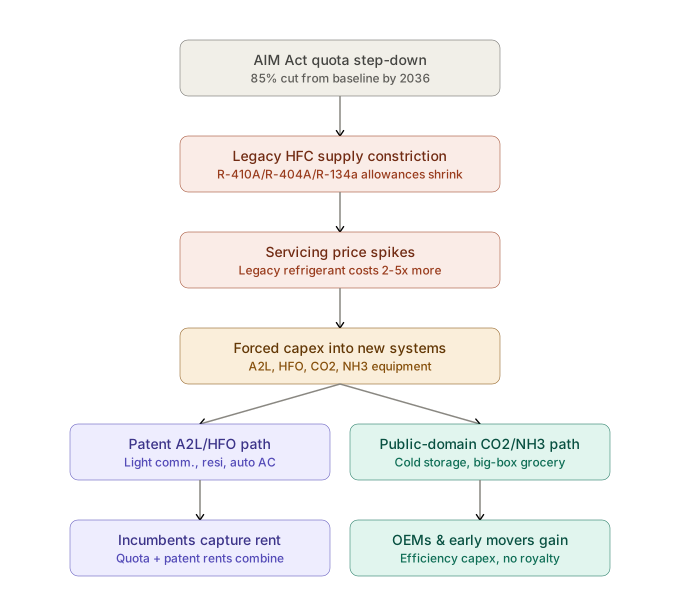
Large industrial cold storage — Americold and Lineage — are not primarily HFC operations. Americold operates 239 cold storage warehouses across 12 countries, with 83% of its sites already running ammonia refrigeration. Ammonia is a natural refrigerant with GWP near zero that was never inside the AIM Act’s HFC quota system. Americold is already deploying transcritical CO2 at new facilities, in one case cutting installed capex by roughly 18% versus a conventional booster design. Lineage carries more legacy exposure — an estimated 356,000 pounds of f-gas refrigerants across roughly 400 global sites — but the direction of its capex is the same: toward ammonia and CO2, not toward patented HFO blends.
The realistic picture: cold storage giants have real legacy-HFC tails to retrofit, but the capital is flowing toward public-domain, patent-free, cheaper-per-pound natural refrigerants — not toward the synthetic chemistry that Chemours and Honeywell sell.
Large-format grocery — Walmart, Target, Aldi, Kroger, Costco — has been implementing transcritical CO2 systems for years, ahead of the mandate. These operators self-fund via ESG-driven capital plans already underway. They are insulated from both the quota squeeze and the patent toll.
Independent and mid-size grocery is the segment most exposed to being caught mid-transition. These operators are too small to justify a full transcritical CO2 rack retrofit — which carries a 15–16% upfront equipment premium — but they face HFC service costs that keep climbing regardless of what EPA does to the equipment-mandate calendar. The EPA’s 2027 rule change (GWP limit raised to 1,400 for new supermarket equipment) was in part a response to this exact segment arguing it needed more time and cheaper interim options. Many will push toward interim GWP-1,400 HFO blends rather than jumping straight to naturals.
Residential and light-commercial AC/heat pumps are locked into the patent-protected synthetic dominance thesis. R-410A is being replaced by R-454B or R-32 — designer blends where Honeywell (Solstice) and Chemours (Opteon) hold formulation IP. A natural-refrigerant swap-in is not practical at this equipment scale. Homeowners bear the cost most directly and least efficiently: whole-home heat pump installs now running roughly $25,000, with total system prices up 20–30% and refrigerant alone up 50–200% in service pricing.
The Quota Rent Extraction Mechanism
The financial evidence for quota rent extraction is unusually explicit. Chemours’ Thermal & Specialized Solutions segment — which houses both Freon (legacy HFC, quota-scarce) and Opteon (patented low-GWP replacement) — posted Opteon revenue up 37% year-over-year in Q4 2025 and 56% for the full year, with segment margins around 32–33%. In Q1 2026, TSS net sales rose 22% year-over-year, split between $313 million in Opteon sales and $162 million in Freon sales. Management’s own earnings-call language credited results to strong “quota execution” alongside Opteon growth — the company is monetizing scarcity in the legacy gas and growth in the patented replacement simultaneously, from the same allowance base.
The mechanism is structurally sound. Allowances are allocated based on historical production share, not auctioned to whoever wants to produce refrigerant. The same handful of producers — Chemours, Honeywell, Arkema, Daikin America — hold both the shrinking legacy-HFC allowance pool and the patents on the replacement chemistry. That is the setup for dual monetization.
The Escape Hatch: Natural Refrigerants
The most important asymmetry in this thesis is that the patent-protected synthetic dominance endpoint is bifurcated, not universal. It is strong in residential/light-commercial/auto, and financially proven at Chemours specifically. But it is considerably weaker in large-format cold storage and big-box grocery, where the money is flowing toward patent-free natural refrigerants precisely to escape both the quota exposure and the chemical royalty.
CO2 is patent-free and available at roughly $1–3 per pound compared with $6+ per pound for HFC refrigerant like R-404A — before you even count equipment costs. Ammonia carries its own safety and regulatory constraints (EPA/OSHA PSM compliance for large charges), but it is a public-domain refrigerant that sits entirely outside the AIM Act’s HFC quota system.
For independent grocers, the CO2 transcritical retrofit carries a 15–16% upfront equipment premium, but the payback window is 4–8 years, driven by lower energy consumption, near-zero fluid replacement costs, and avoidance of future compliance retrofits. The economic math works even without the regulatory mandate — the mandate just accelerates the timeline.
Where the Alpha Lives
As an investment thesis, the cleanest expression of quota-rent capture is in the chemical producers holding EPA production baseline allowances and low-GWP refrigerant patents — Chemours and Honeywell’s refrigerant segments. The dual monetization mechanism is empirically confirmed and financially proven.
But the cold storage and grocery operators committed to natural refrigerants — Americold, Lineage, and CO2-committed grocers — are not the thesis’s liability. They are the escape hatch. They are routing capex away from the patent toll and the quota squeeze, toward public-domain refrigerants that carry their own engineering constraints but no chemical royalty.
The segment most exposed to being caught between these two poles is independent and mid-size commercial refrigeration — too small to justify CO2 rack rebuilds, but facing HFC service costs that keep climbing regardless of political fights over equipment deadlines. That is where the real economic friction concentrates.