
Most analysts frame Waste Management (WM) and Republic Services (RSG) as defensive, utility-like collection networks — boring, stable, low-volatility infrastructure. This framing is wrong because it mistakes the visible business for the actual toll booth.
Garbage trucks are not the moat. The moat is the permitted hole in the ground, and the subsidy stream sitting on top of it.
The Physical Constraint: Land Scarcity, Priced
WM controls roughly 260 landfills across the United States. Republic Services controls about 190. GFL Environmental controls around 100. This concentration is not an accident of corporate strategy — it is the mechanical output of a permitting bottleneck that has effectively closed.
Getting a new landfill permit in most U.S. jurisdictions is practically impossible. Land is scarce, local opposition is fierce, and the regulatory climate only tightens. Every existing permit is a grandfathered asset with effectively infinite replacement cost. The national average MSW tipping fee hit $62.28 per ton in 2024, up roughly 10% from $56.80 in 2023 — the steepest jump since 2022, based on EREF’s survey of 351 active landfills. The same analysis projects the U.S. could exhaust overall landfill capacity in about 18 years at current disposal rates, with MSW generation itself rising approximately 50% by 2050.
Regional dispersion tells the scarcity story even more cleanly. Tipping fees run as low as $30–40 per ton in land-abundant Southern and Midwestern markets versus more than $100 per ton in constrained Northeastern coastal markets, with Massachusetts and Alaska both clearing $120+ per ton. This is not a collection-cost story — it is a land-scarcity story, priced.
Vertical Integration: Converting the Toll Booth Into Margin
The physical constraint only matters if the operator can capture the margin. WM now internalizes roughly 71% of what it collects into its own disposal network rather than paying a competitor’s tipping fee. This 71% internalization rate is driven by an oligopoly-like market structure and a network of landfills that cannot be replicated. Transfer stations are the plumbing that makes this work at scale — they let a hauler aggregate volume and route it to an owned site even when the collection route itself has no local landfill.
WM’s own FY2025 10-K puts the exact count at 253 solid waste landfills, 4 hazardous waste landfills, and 342 transfer stations. The company describes disposal as the scarce, capital-intensive layer of the business, with route collection as the commoditized layer sitting on top of it. Third-party haulers frequently need to dispose of waste at facilities they don’t own, and internalizing that disposal into owned sites lifts consolidated margins and cash flow.
This is showing up exactly where the thesis predicts. WM trades around a $90 billion market cap on roughly $25.7 billion in trailing revenue, with 2025 total operating EBITDA of $7.171 billion, up 13.3%, and adjusted margin exceeding 30% for the first time. Republic Services is smaller (~$64–70 billion market cap) but shows the identical pattern: Q1 2026 revenue growth was driven almost entirely by disciplined pricing — 5.7% core price on total revenue — while organic volume was actually down. Volume can go negative and the toll still rises, because the customer has nowhere else to send the ton.
The RIN Credit Overlay: Real Revenue, Reversible Policy
Now the RNG/RIN layer — real, but a fundamentally different animal.
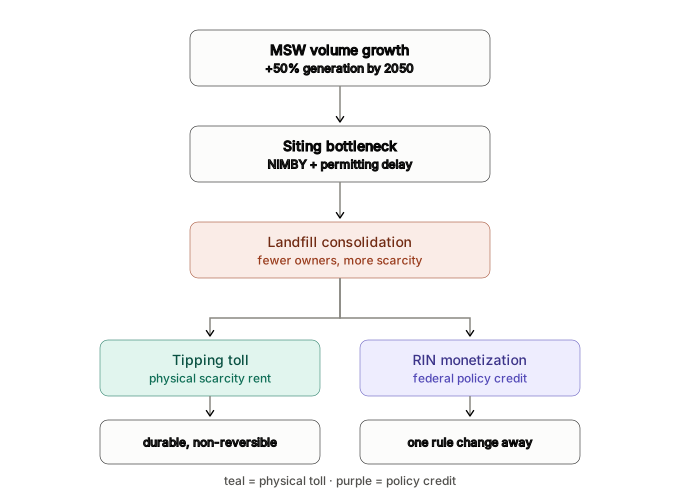
Landfill gas capture is legally mandated at scale thresholds (34 Mg/yr of non-methane organics under the 2016 NSPS/EG rule), which is why WM and RSG already have the gas collection infrastructure that RNG monetization piggybacks on. The credit mechanics are straightforward: EPA’s newly finalized “Set 2” rule set record renewable volume obligations for 2026–2027, and renewable natural gas — largely landfill-derived — now makes up roughly 91% of the entire cellulosic (D3) RVO category in both years. Cellulosic volumes are set at 1.36 billion ethanol-gallon-equivalents for 2026 and 1.43 billion for 2027.
WM and RSG, as the largest landfill-gas producers, are not just participants in the D3 RIN market — collectively they are close to setting its supply curve. WM’s Renewable Energy segment ran $321 million in 2024 revenue, up 16%, at roughly 30.8% operating margin. In Q2 2026, combined adjusted operating EBITDA for recycling and renewable energy grew to $163 million, a 32.5% increase year-over-year.
But here is the tell that this layer is bolt-on, not structural: WM has actively shopped it. The company explored a roughly $3 billion sale of the development rights to its RNG operations across 115 landfills, working with JPMorgan to gauge interest from energy companies and private equity, while planning to retain ownership of the landfills themselves. The physical land and permit stay with WM as the durable asset; the gas-to-credit monetization is treated as a severable financial instrument that can be sold, packaged, or repriced independent of the landfill moat.
It is a genuinely lucrative overlay, but it is not “unassailable” in the way the land is. It is a subsidy stream sitting on top of an unassailable asset, and subsidy streams get rewritten.
The Policy Subsidy Gets Renegotiated — By Design
EPA has already demonstrated it will restructure the credit system mid-flight. In the same 2026 rulemaking that set record-high D3 volumes, the agency eliminated the renewable-electricity (eRIN) pathway entirely, partially waived the 2025 cellulosic volume requirement outright, and deferred a planned 50% cut to import-derived RIN credits until 2028 rather than implementing it immediately. The rules get renegotiated every compliance cycle, by design.
The Trump EPA has been rolling back methane-reporting rigor, not tightening it. The agency finalized a rule formally rescinding the 2009 Greenhouse Gas Endangerment Finding, which undermines the statutory authority for economy-wide greenhouse gas reporting. For landfills specifically, EPA extended the deadline for states to submit implementation plans for existing-landfill methane rules and proposed eliminating the greenhouse gas reporting requirement (Subpart HH) for landfills altogether. The underlying 2016 gas-collection trigger has not been repealed, but the compliance-monitoring apparatus around it is being loosened.
What Else Belongs in the Moat
Three additional layers that most framings leave out:
Municipal franchise contracts. Residential collection in most cities runs through exclusive, competitively-bid, multi-year municipal contracts — a separate switching-cost moat from landfill siting. WM and RSG can push 80% of contracts on CPI- or fuel-indexed pricing, with commercial and industrial pricing growing nearly 5% year-over-year even as volumes soften.
Specialty and regulated waste streams. WM’s Stericycle acquisition (medical waste, secure destruction) extends the same permitting-scarcity logic into a second regulated vertical, at pricing WM itself has flagged running up to $1,000 per ton versus standard MSW rates — a much higher-margin toll on a much narrower moat.
Capital intensity as its own barrier. Building, lining, monitoring, and eventually closing and post-closure-monitoring a landfill for decades is expensive enough that even a hypothetical permit would not attract entrants without balance sheets like WM’s or RSG’s.
The One-Line Thesis
Durable land monopoly, with a lucrative but reversible policy subsidy riding on top of it.
The physical constraint — the permitted hole in the ground — is close to permanent. There is no technology risk (nobody disrupts a landfill with an app), no substitute good, and demand is compulsory and non-discretionary. The RIN/RNG layer is a real and currently very profitable second income stream, but it is federal-policy-dependent, resets every compliance cycle, and is separable from the land itself.
Worth flagging the other side of the ledger: organics-diversion laws (composting/food-waste mandates now spreading state by state) are a slow-moving threat to the methane feedstock itself, and long-tail post-closure environmental liability is the moat’s structural cost, not just its upside.
The mundane part is precisely why it is strategic. Most defensive utilities face regulatory repricing, technological disruption, or demand cyclicality. WM and RSG face none of these on the core asset. The land monopoly is the constraint; the policy subsidy is the optionality. Treat them as separate layers, price them accordingly, and do not confuse a reversible federal credit with a permanent physical toll.