
The Taiwan Strait is not a geopolitical abstraction. It is the single largest concentration of advanced semiconductor fabrication capacity on Earth. Taiwan produces 92% of the world’s most advanced logic chips at node sizes below 10 nanometers. TSMC alone accounts for an estimated 35% of global automotive microcontrollers and 70% of smartphone chipsets. The overseas fabs in Arizona, Kumamoto, and Dresden are growing, but they remain a minority of leading-edge capacity — Taiwan’s share of global foundry capacity is only projected to fall to 41% by 2027.
For the 2026 base case, a Strait closure hits both ends of the value spectrum: the highest-value AI and logic chips, and the lowest-margin commodity chips that almost everyone assumes are replaceable elsewhere.
The question is not whether Taiwan matters. The question is what breaks first, how fast, and what the actual gating constraint is.
The Inventory Buffer Map
The most useful way to think about a Strait closure is as a supply chain stress test with asymmetric timing. Different segments carry different inventory buffers, and the difference between 100 days of stock and 2 weeks of stock is the difference between a manageable disruption and a cascading failure.
The AI and data-center logic segment sits on the most resilient buffer. Nvidia’s days-inventory hit approximately 105 in April 2026, up sharply from roughly 56 a year prior. This is built-up finished product and component stock, not raw wafer supply — new starts halt immediately even if shipped product keeps flowing for a while. The general and non-AI distributor channel has normalized back to historical norms through mid-2026, with distributor stock inside historical ranges and bookings at three-year highs.
The thin buffers are where the real vulnerability lives. Automotive, industrial, and power ICs — mostly made on Taiwan’s mature nodes at TSMC’s older fabs, UMC, PSMC, and VIS — are operating with lead times of 26 to 52+ weeks. Firms are holding safety stock far below replacement time. This is the same segment that broke first in the 2020-21 shortage, and the underlying vulnerability has not been fully resolved, just papered over by demand cycles. Memory (DRAM and NAND) is similarly thin and tightening further, with AI demand drawing down channel inventory hard enough that SK Hynix has warned the shortage could persist past 2030. Apple runs an intentionally lean just-in-time model at the finished-product level — the real buffer sits a layer up, in contract-manufacturer component stock and pre-secured capacity commitments.
What Breaks First
The first casualty is not the AI chips. It is the boring ones.
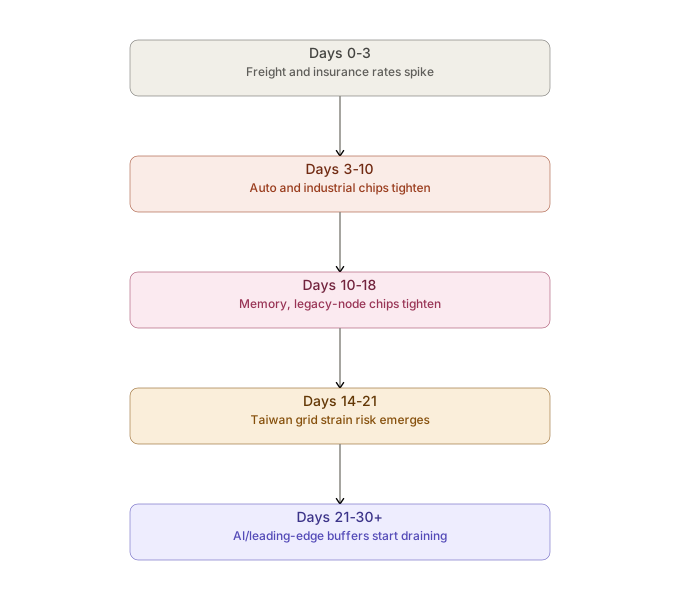
Automotive and industrial-grade chips, mostly fabricated on Taiwan’s mature nodes, have the thinnest relative safety stock because lead times are already stretched to six to twelve months and there are few qualified second sources. Expect measurable strain within roughly one to two weeks of a real closure. Memory follows closely behind for the same reason — inventory is already tight because AI demand has been eating the buffer all year.
The AI and leading-edge chips are actually the most resilient in the short run, precisely because Nvidia and its peers are sitting on unusually large finished and component inventories, and CoWoS and HBM allocation for 2026 is already locked in. Mid-2026 foundry allocation shows TSMC’s CoWoS fully booked with approximately one million wafers of 2026 demand already committed.
The catch is the delayed cliff. None of that inventory gets replenished during the closure. Shipments look fine for weeks, then bookings 60 to 90+ days out fall off a cliff as the work-in-progress pipeline runs dry, and spot prices spike immediately on panic-buying even before physical shortages appear.
The Energy Constraint
The wildcard that could override all of this is energy. Taiwan imports approximately 97% of its energy and currently holds roughly 11 to 14 days of LNG reserve. A real-time stress test of this exact vulnerability is happening right now via the Strait of Hormuz, which has been effectively closed since March 4, 2026 due to the Iran conflict. Taiwan has been drawing down reserves and scrambling extra shipments as a result.
If a Taiwan Strait closure also constrained LNG shipping — plausible, since much of it transits the same sea lanes — grid stability, not blocked chip shipments, could become the actual gating constraint on TSMC output within two to three weeks. Taipei would have to start rationing power across the whole economy to keep the fabs running. The foundries cannot operate without electricity, and the electricity cannot arrive without shipping lanes.
The Economic Scale
The modeled full-year estimates put a 12-month blockade at over $2 trillion in trade and value-added at risk by Rhodium Group’s conservative estimate, to roughly $5 trillion in first-year global GDP loss by Bloomberg Economics’ model — approximately 5% of global GDP, with Taiwan down roughly 12%, China roughly 9%, and the United States roughly 3%. A full invasion and war scenario roughly doubles that to approximately $10 trillion, roughly 10% of global GDP.
A 30-day closure is obviously a fraction of an annualized figure, but the damage is front-loaded. The freight, insurance, and panic-buying costs hit almost immediately. The physical chip shortage effects lag by one to four weeks depending on segment. The sequencing matters more than the magnitude.
The Near-Term Trajectory
The consensus view among the most credible trackers — ISW and AEI’s joint China Military Affairs Project, the Council on Foreign Relations — is that the likeliest near-term path is continued gray-zone coercion: drills, incursions, quarantine rehearsals, not a sudden blockade or invasion. Most serious planners treat 2027 as a planning horizon rather than a prediction.
The data supports this read. China is running live-fire drills in the Strait right now — a two-day exercise near Dongshan Island in Fujian that began July 23, the day after U.S.-China talks between Secretary of State Rubio and Foreign Minister Wang Yi touched on Taiwan. Taiwan just ran its own Joint Defense Exercise, July 13 to 17, rehearsing urban defense of Taipei, ahead of the annual Han Kuang exercises, which this year were explicitly built around a 2027 invasion scenario. PLA aerial incursions into Taiwan’s ADIZ have been running above 300 per month since Lai Ching-te took office, though with real variance. China ran a full blockade-simulation exercise, Justice Mission 2025, on December 29 to 30.
The PLA’s internal-politics uncertainty — two Central Military Commission members removed in January 2026 — adds another variable to how the PLA would actually perform in a contingency. China is also leaning economically and informationally on Japan over Prime Minister Takaichi’s comments that Japan might intervene in a Taiwan contingency, a pressure campaign that so far has not moved Tokyo.
The most policy-relevant version of the 30-day closure question is a quarantine or blockade of commercial shipping rather than a shooting war. One academic scenario analysis puts a short-of-invasion quarantine scenario as the most probable disruptive event before 2027.
The Sequencing
A Taiwan Strait closure is not a uniform shock. It is a supply chain stress test with asymmetric timing, and the sequencing determines the damage.
The automotive and industrial chips break first, within one to two weeks, because the inventory buffer is already thin and lead times are stretched. Memory follows closely behind. The AI chips are the most resilient in the short run because of the unusually large inventory build at Nvidia and its peers, but the replenishment cliff hits 60 to 90 days out. The energy constraint could override everything if LNG shipping is constrained, turning grid stability into the gating factor within two to three weeks.
The operational takeaway is that the inventory buffer map is the actual early-warning system. If you are tracking semiconductor supply chain risk, the question is not whether Taiwan matters — it is which segment you are exposed to, how many days of buffer you have, and whether your energy supply is contingent on the same sea lanes as your chip supply.